Tell us about the job
Takes about a minute. No obligation.
A boiler repair in Eagle County starts with what the equipment has already been through. Homes in Eagle County, CO run heat about eleven months a year, from August through June. The burner, heat exchanger, and ignition system cycle through that kind of continuous demand, and wear accumulates on each of them in ways a contractor has to sort out before they can quote a repair. A failed ignition component in a system that has run that long could point to a discrete fault, or it could point to the heat exchanger having degraded around it. The contractor has to open the system and look.
Boilers in older housing stock tend to outlast their own parts supply. Half the homes in Eagle County, Colorado were built in 1993 or earlier (2020-2024 ACS 5-year). A contractor who opens a boiler in a house from that era is likely working on a system whose heat exchanger seals, zone valves, or pressure relief components come from a shrinking pool of compatible stock, and some no longer come at all. That shifts how a repair gets priced: a part that still exists gets ordered and swapped, and a part that does not restarts the job as a sizing conversation for a replacement.
The Parts of a Boiler a Contractor Checks First
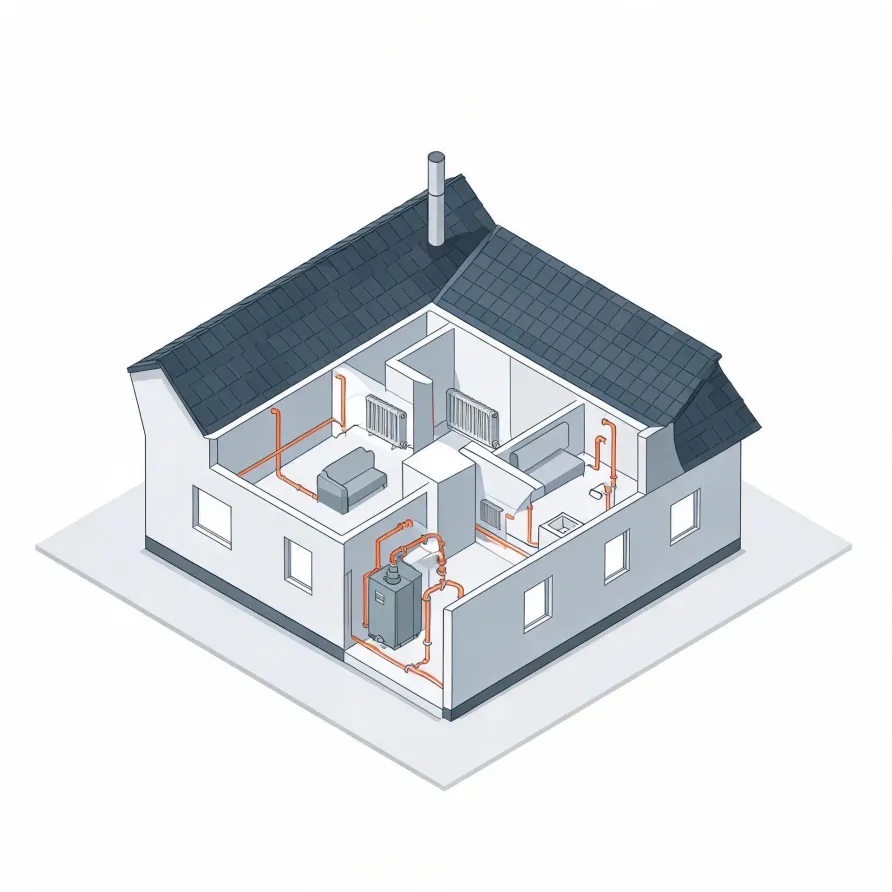
The boiler itself sits in the basement or mechanical room and is the piece a contractor goes to first. Inside it, the heat exchanger is the part most likely to be behind a heating failure or a pressure problem. The circulator pump, mounted directly on the boiler, is what pushes hot water through the system, and when it fails the heat stops moving.
From the boiler, supply and return pipes run through the house to radiators or radiant floor loops in each room. The expansion tank, usually hanging near the boiler, absorbs pressure changes as water heats and cools. The pressure relief valve and the thermostat controls round out what a contractor examines when tracing a fault.
The drawing shows a typical boiler layout, and a licensed contractor determines which components and conditions apply to your specific home.
Get matched in Eagle CountyEagle County, by the numbers
158 severe weather events were recorded in Eagle County, Colorado between 2015 and 2024.
NOAA National Centers for Environmental Information, Storm Events Database, bulk CSV export, events 2015-01-01 through 2024-12-31.Half the homes in Eagle County, Colorado were built in 1993 or earlier (2020-2024 ACS 5-year).
U.S. Census Bureau, 2020-2024 American Community Survey 5-Year EstimatesEagle County, Colorado holds 33,915 housing units (2020-2024 ACS 5-year).
U.S. Census Bureau, 2020-2024 American Community Survey 5-Year EstimatesOwners occupy 65.9% of the occupied homes in Eagle County, Colorado (2020-2024 ACS 5-year).
U.S. Census Bureau, 2020-2024 American Community Survey 5-Year EstimatesSevere Weather Events in Eagle County
Boilers in Eagle County work against whatever the climate puts on them, and storm loads accelerate wear on components that might otherwise hold for years. How often severe weather hits a county shapes how hard local heating systems work and how often they need attention.
158 severe weather events, 2015–2024. Source: NOAA National Centers for Environmental Information, Storm Events Database.