Tell us about the job
Takes about a minute. No obligation.
Homes in Summit County, CO run heat in every month of the year. The burner fires and the ignition system cycles through every month without a summer break to sit idle, and that continuous load shows up in the parts that trigger each heating cycle. A contractor called to a Summit County boiler fault checks the ignition assembly and burner first, because those components have never had a dormant season to reduce their cycle count. The heat exchanger and circulation pump matter, but the ignition system takes the first hit.
Piping and zone controls in housing this old carry the record of every fix and workaround a previous owner called in, and what looks like a single boiler fault often traces back to a distribution system that has been adapted more than once. Half the homes in Summit County, Colorado were built in 1989 or earlier (2020-2024 ACS 5-year). A contractor opening a boiler here checks not just the heat exchanger and the burner assembly but whether the piping feeding each zone is still configured in a way that matches how the boiler is now being asked to run. Parts availability for systems this vintage is the other variable: some components are still manufactured, some are not, and that answer changes what a repair costs before a single part is ordered.
The Parts of a Boiler a Contractor Checks First
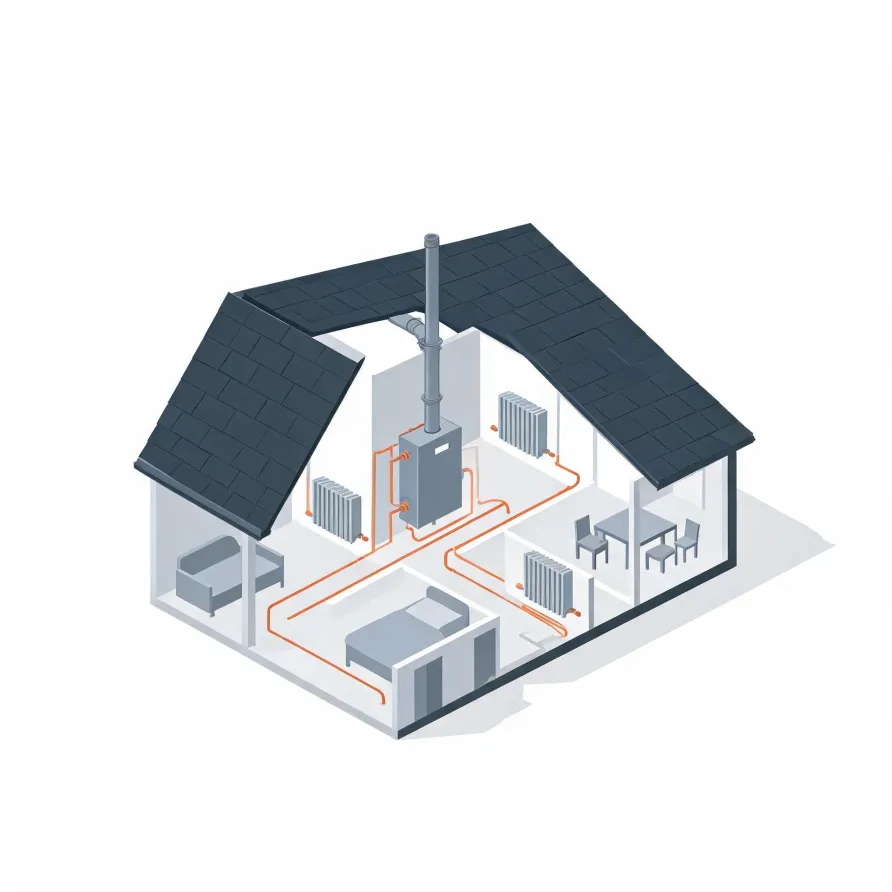
The boiler itself sits in the basement or mechanical room and is the heart of the system. A burner inside it fires to heat water, and when that burner, heat exchanger, or pressure relief valve is the source of trouble, the whole system either underperforms or shuts down. Those components are where a contractor looks first.
From the boiler, pipes carry hot water to radiators or baseboard units in each room, and a circulator pump keeps that water moving through the loop. The expansion tank, usually mounted near the boiler, absorbs pressure swings in the system. A faulty pump or a waterlogged expansion tank can mimic a boiler problem, so both get checked alongside the main unit.
The drawing shows a typical boiler system layout, and a licensed contractor determines which components apply and what condition they are in for your specific home.
Get matched in Summit CountySummit County by the Numbers
89 severe weather events were recorded in Summit County, Colorado between 2015 and 2024.
NOAA National Centers for Environmental Information, Storm Events Database, bulk CSV export, events 2015-01-01 through 2024-12-31.Half the homes in Summit County, Colorado were built in 1989 or earlier (2020-2024 ACS 5-year).
U.S. Census Bureau, 2020-2024 American Community Survey 5-Year EstimatesSummit County, Colorado holds 32,251 housing units (2020-2024 ACS 5-year).
U.S. Census Bureau, 2020-2024 American Community Survey 5-Year EstimatesOwners occupy 72.1% of the occupied homes in Summit County, Colorado (2020-2024 ACS 5-year).
U.S. Census Bureau, 2020-2024 American Community Survey 5-Year EstimatesSevere Weather Events in Summit County
Summit County's climate puts real strain on boiler systems, and that strain compounds with every weather event that pushes temperatures to extremes or disrupts power. How hard the equipment works here is a local fact, and local repair needs follow from it.
89 severe weather events, 2015–2024. Source: NOAA National Centers for Environmental Information, Storm Events Database.