Tell us about the job
Takes about a minute. No obligation.
Homes in Denver County, CO run heat about eight months a year, from October through May. That runtime lands almost entirely on the burner, the heat exchanger, and the ignition system, which cycle on and off through every cold stretch from fall through late spring. A contractor repairing a boiler here checks those parts first, because they have absorbed the full weight of every heating season the system has run. Cracks in a heat exchanger and fouled ignition components are the findings that come up repeatedly, and they come up because the load is real and sustained.
Piping runs, zone valves, and expansion tanks in a house this old were sized and laid out for whatever originally heated the place, and that original equipment is almost certainly gone. Half the homes in Denver County, Colorado were built in 1975 or earlier (2020-2024 ACS 5-year). A contractor opening a boiler here has to account for what the distribution side has become across that span of replacement and adaptation, not just what the boiler itself shows. A corroded section of baseboards or an undersized circulator pump can drive the fault the homeowner called about even when the boiler itself tests clean.
The Parts of a Boiler a Contractor Checks First
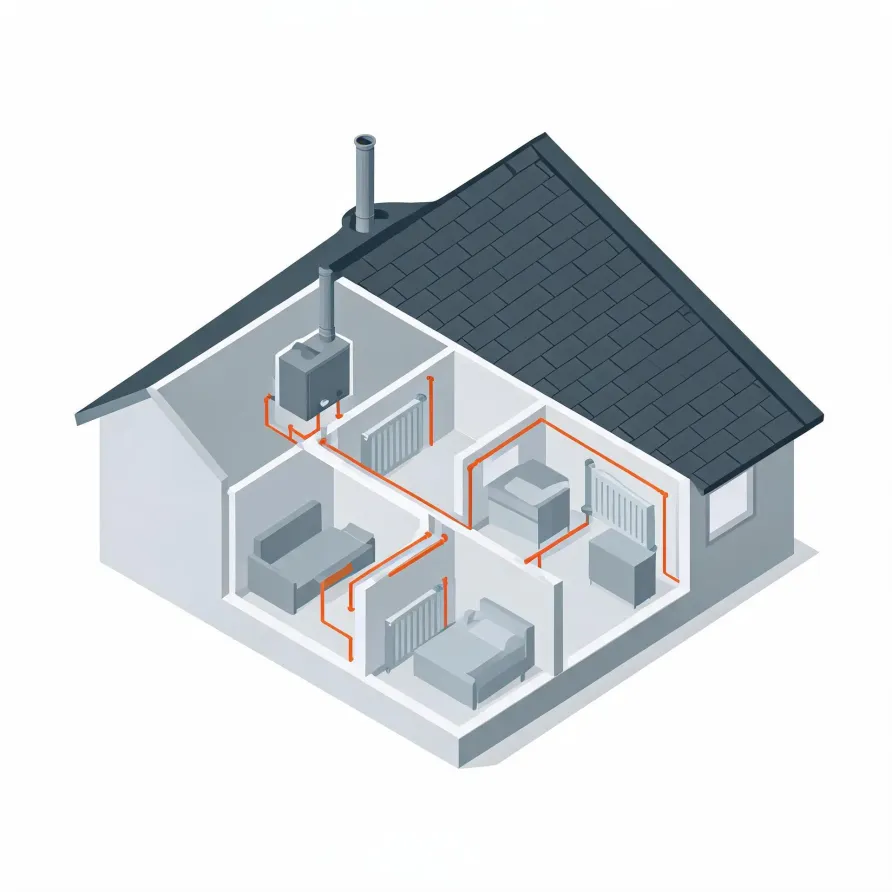
The boiler itself sits in a mechanical room, basement, or utility closet and is the piece a contractor reaches first. It heats water and circulates it through the system. When a boiler malfunctions, the fault often traces back here: a failed burner, a cracked heat exchanger, a pressure problem, or a faulty thermocouple.
Radiators or baseboard convectors sit in the living spaces and are where heat actually enters the rooms. The expansion tank, circulator pump, and relief valve all connect to the boiler and each has a specific job. A stuck circulator, a waterlogged expansion tank, or a weeping relief valve will each produce distinct symptoms that tell a contractor where to look.
The drawing shows a typical boiler layout, and a licensed contractor determines which components apply to the specific system in your home.
Get matched in Denver CountyDenver County, by the numbers
243 severe weather events were recorded in Denver County, Colorado between 2015 and 2024.
NOAA National Centers for Environmental Information, Storm Events Database, bulk CSV export, events 2015-01-01 through 2024-12-31.Half the homes in Denver County, Colorado were built in 1975 or earlier (2020-2024 ACS 5-year).
U.S. Census Bureau, 2020-2024 American Community Survey 5-Year EstimatesDenver County, Colorado holds 359,581 housing units (2020-2024 ACS 5-year).
U.S. Census Bureau, 2020-2024 American Community Survey 5-Year EstimatesOwners occupy 48.8% of the occupied homes in Denver County, Colorado (2020-2024 ACS 5-year).
U.S. Census Bureau, 2020-2024 American Community Survey 5-Year EstimatesSevere Weather Events in Denver County
Denver's climate puts real stress on boiler systems, and weather events drive a significant share of repair demand. How hard the equipment works, and how often it fails, is a local question.
243 severe weather events, 2015–2024. Source: NOAA National Centers for Environmental Information, Storm Events Database.